Fresh and frozen seafood can both be good choices. The better option depends on what you are cooking, when you will use it, how much storage space you have and whether consistent portions matter.
The word “fresh” does not automatically mean better quality, and “frozen” does not automatically mean lower quality. What matters most is the seafood’s condition, how it was handled, whether the cold chain was maintained and whether the product suits your needs.
This guide compares fresh and frozen seafood for Singapore households, restaurants, caterers and retailers.
Quick answer: fresh or frozen seafood?
Choose fresh seafood when you plan to cook it soon, want to inspect a whole fish or specific cut closely, or need a texture and presentation best assessed at the counter.
Choose frozen seafood when you need a longer planning window, convenient portioning, more predictable stock or access to products outside their local season.
Neither format is automatically superior. A well-handled frozen product can be a better purchase than fresh seafood that has been held too long or outside proper temperature control.
Fresh vs frozen seafood at a glance
| Factor | Fresh or chilled seafood | Frozen seafood |
|---|---|---|
| Best suited for | Near-term cooking and close visual selection | Advance planning, stock management and portion flexibility |
| What to inspect | Smell, firmness, eyes and gills for whole fish, surface condition and temperature | Frozen condition, packaging or container, frost, ice crystals, damage and product information |
| Storage | Chiller or refrigerator at 4°C and below | Freezer at -18°C or below |
| Preparation | Usually ready to portion and cook | May require controlled thawing or cooking from frozen according to instructions |
| Planning risk | Shorter usable window and more sensitivity to delayed use | Requires freezer capacity and thawing time |
| Cost comparison | Consider trimming, yield, spoilage risk and preparation labour | Consider glaze, thaw loss, portion consistency and freezer cost |
What “fresh” seafood actually means
Fresh seafood is generally sold chilled rather than frozen at the point of sale. That description alone does not tell you when it was harvested or how long it has been in distribution.
Some seafood displayed as fresh may also have been previously frozen and then thawed for sale. The US Food and Drug Administration notes that previously frozen fish may not show every visual characteristic associated with never-frozen fish, but it should still smell fresh and mild rather than sour, rancid or strongly fishy.
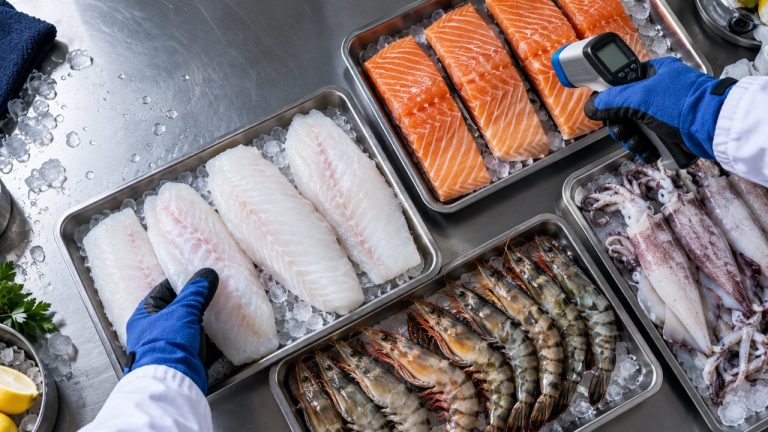
When choosing fresh fish, assess the actual product:
- the flesh should look firm and in good condition
- whole fish should have clear eyes and healthy-looking gills
- fillets should not show excessive drying or darkening at the edges
- the seafood should be properly chilled or displayed on sufficient ice
- there should be no sour, rancid or ammonia-like odour
Colour alone is not a reliable freshness test because it can vary with species, diet, environment and processing. For a more detailed buying checklist, read How to Choose Fresh Seafood in Singapore.
What freezing does to seafood
Freezing slows the processes that cause food to deteriorate, but it does not improve seafood that was already in poor condition. The quality of a frozen product depends on the seafood before freezing, the freezing method, packaging and temperature control throughout storage and delivery.
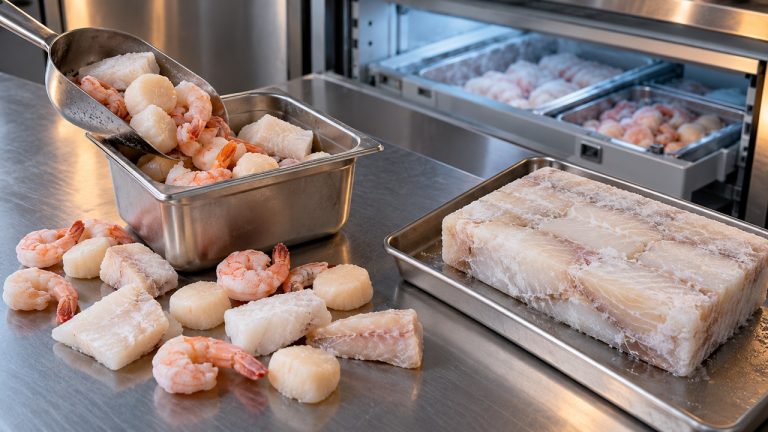
Good frozen seafood should be hard and properly frozen. Look for intact packaging or a clean, suitable container. Large amounts of loose ice, heavy frost, damaged cartons, leaking liquid or a product that has become soft can justify a closer check.
Freezing can change texture, especially if temperature fluctuates or if the product is thawed incorrectly. However, a well-managed frozen format can provide reliable quality and make portion planning easier.
For a full receiving checklist, see How to Check Frozen Seafood Quality in Singapore.
Which format gives better quality?
There is no universal winner. Compare the condition of the actual products rather than relying only on the words “fresh” and “frozen”.
Fresh seafood may be the better choice when:
- you can verify that it has been handled well
- you plan to cook it soon
- whole-fish appearance is important to your selection
- a particular dish depends on a texture you have assessed in person
Frozen seafood may be the better choice when:
- it was frozen in good condition and kept consistently frozen
- you need stock for later use
- the product is portioned in a way that reduces preparation work
- predictable size and availability matter more than counter display
For food businesses, write the required cut, size, pack format, weight basis and acceptable condition into the purchase specification. This makes quality measurable instead of subjective.
Which is more convenient?
Fresh seafood removes the thawing step, but it requires faster purchasing and production decisions. Frozen seafood allows more advance planning, provided there is enough freezer capacity and stock is rotated correctly.
For households, frozen portions can make it easier to cook only what is needed. For restaurants and caterers, a suitable frozen format may support consistent portions and reduce last-minute shortages. These benefits depend on the actual pack format, so confirm whether pieces are individually frozen, block frozen or packed in another form before ordering.
Frozen seafood still needs planning. Move only the required quantity into controlled thawing and allow enough time before service. Do not leave seafood to thaw at room temperature.
Which costs less?
Do not compare only the price per kilogram. The lower-priced item can become more expensive after waste, trimming, glaze, thaw loss, labour and unused stock are considered.
Compare total usable cost:
- Purchase price and ordered weight
- Edible yield after skin, shell, bone or trimming
- Ice glaze and expected thaw loss
- Portion consistency
- Preparation labour
- Spoilage or unsold-stock risk
- Chiller or freezer space required
Fresh seafood may offer excellent value when demand is known and the product will be used quickly. Frozen seafood may support better stock control when demand varies. The right choice is the one that gives the required quality at the lowest total usable cost, not simply the lowest invoice price.
Food safety applies to both formats
Fresh and frozen seafood both require temperature control and hygienic handling. Freezing does not make raw seafood ready to eat, and thawed seafood should be handled with the same care as fresh raw seafood.
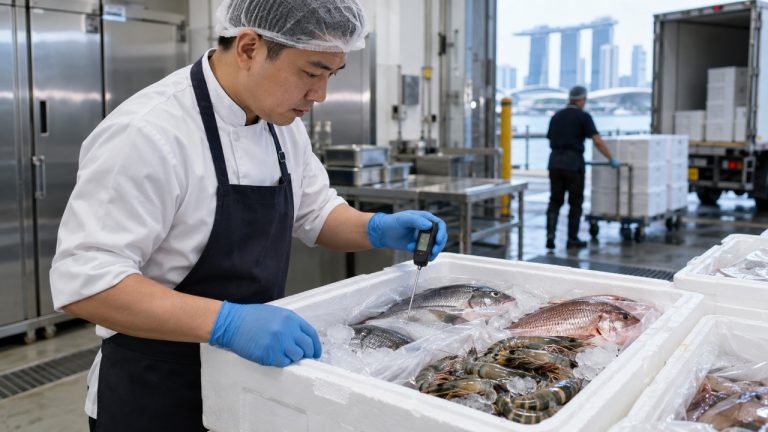
The Singapore Food Agency advises keeping fridges and chillers at 4°C and below and freezers at -18°C or below. It also advises thawing frozen meat and seafood in the refrigerator or microwave, placing it in a container on the bottom shelf to prevent juices from contaminating cooked or ready-to-eat food.
Practical controls include:
- buy chilled and frozen food near the end of the shopping trip
- use an insulated bag or cooler box for transport when appropriate
- keep raw seafood covered and separate from ready-to-eat food
- wash hands, knives, boards and work surfaces after handling raw seafood
- follow pack or supplier instructions for storage, thawing and cooking
- cook seafood thoroughly, especially for young children, pregnant women, older people and people with illnesses
For storage and thawing guidance, read How to Store Frozen Seafood Safely in Singapore.
A practical buying decision for households
Ask four questions:
- When will I cook it? Choose a product that fits the actual meal plan.
- Can I keep it at the correct temperature? Do not buy more than the refrigerator or freezer can manage safely.
- How much will I use? Select a pack or portion format that avoids unnecessary thawing and waste.
- Does it suit the dish? A whole fish, fillet, steak, prawn or squid product may each need a different quality check and preparation method.
If you are unsure, buy from a supplier who can explain the product form, storage requirements and whether it has been previously frozen.
A practical buying decision for food businesses
Many kitchens use both fresh and frozen seafood. The best purchasing plan may assign each format to the job it performs best.
Use fresh seafood for items that move quickly and where counter-selected appearance or a specific near-term preparation matters. Use frozen seafood for suitable menu items that benefit from advance stock, consistent portions or a wider ordering window.
Before ordering, confirm:
- exact species or product name
- fresh, chilled, previously frozen or frozen condition
- cut, size, grade and processing method
- pack format and weight basis
- storage and delivery requirements
- expected remaining shelf life, where applicable
- traceability and allergen information
- process for shortages, damage or rejected goods
For broader supplier checks, use How to Choose a Seafood Supplier in Singapore.
Frequently asked questions
Is frozen seafood less fresh than chilled seafood?
Not necessarily. Product quality depends on condition before freezing, how quickly and effectively it was frozen, packaging, storage temperature and handling after thawing. Judge the actual product and supply chain rather than the format alone.
Can thawed seafood be frozen again?
The Singapore Food Agency advises consumers not to refreeze food that has been thawed. Plan portions before thawing and follow the product’s instructions.
Is fresh seafood always better for restaurants?
No. Fresh seafood can be suitable for fast-moving menu items, while frozen seafood can support planning and portion consistency. Restaurants should compare specification, yield, labour, storage and expected demand.
Can frozen seafood be used for raw dishes?
Do not assume that any fresh or frozen seafood is suitable for raw consumption. Use only seafood specifically supplied for that purpose and follow applicable food-safety requirements and supplier instructions.
How do I know whether seafood was previously frozen?
Check the package, display information or product documentation and ask the seller or supplier. Do not try to determine it from appearance alone.
Choose based on use, not assumptions
Fresh and frozen seafood are different supply formats, not simple quality grades. The best purchase is properly handled, accurately described and suited to the dish, storage capacity, preparation plan and expected demand.
Pan Ocean Singapore supplies seafood to retail, food-service and wholesale customers. Contact our team to discuss available product formats, specifications and delivery requirements.