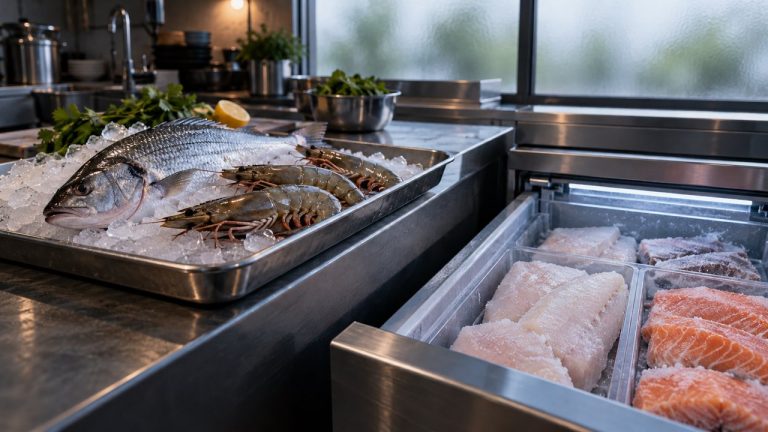
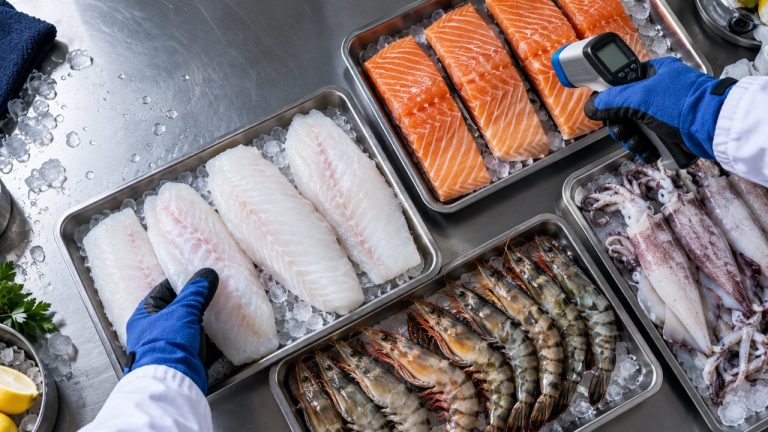
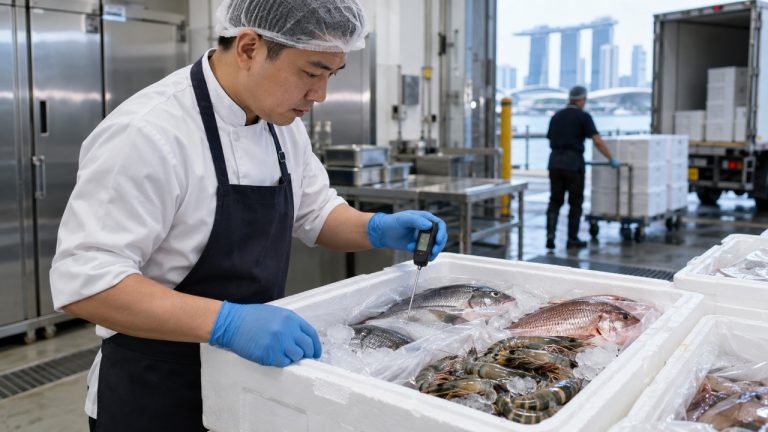
Individually quick frozen (IQF) and block-frozen seafood can both work well in a professional kitchen. The better format depends on how much you use at one time, how predictable demand is, how you thaw and portion stock, and how much freezer space you have.
The short answer is simple: IQF is usually more flexible for variable demand and portion-by-portion use, while block-frozen seafood can suit predictable, high-volume batch production. Neither format is automatically higher quality. Product condition, specification, packaging and cold-chain control still matter.
This guide helps restaurants, caterers, central kitchens and retailers compare the two formats before ordering.
What does IQF seafood mean?
IQF means individually quick frozen. The Food and Agriculture Organization of the United Nations describes IQF fish as individual fillets, whole fish, portions or products that remain separate after freezing.
Because the pieces are separate, a kitchen can remove the amount needed and leave the rest frozen. This can be useful when daily sales vary, several menu items use the same seafood, or the kitchen needs precise portion control.
IQF describes the product format and freezing process. It does not by itself confirm species, grade, size, net weight, glaze level, origin or suitability for a particular dish. Those details should still appear in the purchase specification.
What is block-frozen seafood?
Block-frozen seafood is frozen together in a compact block. FAO references describe fish blocks as fish or fish products frozen in large, regular blocks, commonly for dense storage and later processing.
A block may contain whole fish, fillets, portions or processed seafood, depending on the product. Some blocks use interleaving material so individual pieces can be separated with limited tempering. Others are intended to be thawed and processed as a complete unit.
The key operational question is therefore not only whether the product is block frozen. It is how much of the block must be thawed or tempered before the kitchen can use it safely and efficiently.
IQF vs block-frozen seafood at a glance
| Factor | IQF seafood | Block-frozen seafood |
|---|---|---|
| Portion flexibility | Remove individual pieces or a measured quantity | Often handled as a full block or larger batch |
| Best demand pattern | Variable or uncertain daily demand | Predictable, high-volume use |
| Preparation planning | Can reduce the quantity thawed at one time | Requires planned thawing or tempering for the block |
| Waste control | Useful when only small quantities are needed | Efficient when the full block can be used promptly |
| Storage form | Loose pieces or portions require suitable packaging and airflow | Compact shape can use storage space efficiently |
| Common operational risk | Open packs, poor resealing, dehydration or stock mixing | Thawing more than required or uneven thawing of a large unit |
| Buying focus | Piece count, size range, glaze, net weight and portion consistency | Block weight, piece arrangement, interleaving and intended thawing method |
When IQF is usually the better operational fit
IQF can be useful when a kitchen needs to respond to changing orders without thawing a larger quantity than required.
It is often a good fit when:
- daily demand varies
- seafood is used across several dishes
- the kitchen portions by piece or weight
- small batches are prepared throughout the day
- menu testing or seasonal specials require limited quantities
- avoiding unnecessary thawing is more important than compact block storage
For example, a caterer may need different quantities of prawns for several event sizes. Separate frozen pieces allow the kitchen to measure what is needed for each production run.
IQF does not remove the need for stock control. Open packaging should be closed securely, product identity and lot information should remain traceable, and loose pieces should not be mixed across unidentified batches.
When block-frozen seafood can be the better fit
Block-frozen products can work efficiently when the business uses a known quantity in one production cycle.
They are often suitable when:
- production volume is stable and predictable
- a whole block will be processed shortly after controlled thawing
- the kitchen prepares large batches in a central production schedule
- compact freezer storage is important
- the product will be cut, minced, breaded or otherwise processed in volume
- the block format matches an established recipe and yield calculation
A central kitchen that uses the same volume of fish in each scheduled production run may gain little from paying for individual portion flexibility. In that situation, block weight, usable yield, thawing time and workflow fit may matter more.
Block frozen does not mean lower quality. Quality depends on the raw material, freezing rate, packaging, storage temperature and handling. The practical risk comes when a business thaws a full block but cannot use it within its safe production plan.
Compare total usable cost, not only price per kilogram
The cheaper invoice price is not always the lower operational cost. Compare the cost of the seafood that reaches the plate or production line.
Include:
- purchase price and whether the quoted weight is gross or net
- ice glaze and expected thaw loss
- edible yield after trimming
- portion consistency and over-portion risk
- labour needed to separate, thaw, trim and portion
- unused thawed product and production waste
- packaging and freezer space
- rejected or damaged stock procedures
An IQF product may justify a higher unit price if it reduces unused thawed stock and labour. A block may be more economical when the entire unit is used predictably. Calculate both options against your actual menu, batch size and sales pattern.
For a broader purchasing review, use our seafood supplier checklist for Singapore food businesses.
What to confirm before ordering
Ask the supplier for a written product specification. At minimum, confirm:
- exact product and species name
- cut or product form
- IQF, block frozen or another format
- size range, piece count or block weight
- net weight and whether glaze is excluded
- pack size and inner-pack arrangement
- country of origin and processing location, where applicable
- storage temperature and shelf-life information
- intended thawing or cooking instructions
- lot identification, traceability and allergen information
For block-frozen items, ask whether pieces are interleaved and whether the block is designed to be separated while still partially frozen. For IQF items, ask about size tolerance and the condition expected after thawing.
When receiving stock, check that it is properly frozen and that packaging or containers are clean and intact. Our guide on checking frozen seafood quality covers practical receiving checks.
Storage and thawing controls in Singapore
The Singapore Food Agency advises keeping freezers at -18°C or below and chillers at 4°C or below. It also advises businesses and consumers not to thaw frozen food at room temperature.
SFA’s thawing guidance recommends thawing in a chiller maintained between 0°C and 4°C, using a microwave when appropriate, or using ice water when the food is sealed in a clean, leak-proof package and the water is changed frequently. It also advises thawing only the amount required, cooking thawed food promptly and not refreezing thawed food.
For food businesses, plan the thaw around the size and shape of the product:
- move only the quantity required into controlled thawing
- use clean containers that prevent raw juices from contaminating other food
- store raw seafood below cooked or ready-to-eat food
- allow enough time for the centre of a block to thaw safely and evenly
- follow the product’s instructions and the kitchen’s food-safety plan
- record stock rotation and use older stock first
For a fuller overview, read How to Store Frozen Seafood Safely in Singapore.
A five-question decision checklist
Before choosing IQF or block frozen, ask:
- How much do we normally use in one production cycle? Match the pack format to the real batch size.
- How predictable is daily demand? Variable demand generally increases the value of portion flexibility.
- Can we thaw the product safely and on time? Large blocks need adequate chiller space and planning.
- What is the usable yield? Compare net weight, glaze, thaw loss, trimming and waste.
- Which format fits our labour and storage capacity? The best price can be lost through extra handling or poor freezer organisation.
Businesses do not need to choose one format for every product. Many operations use IQF for variable-demand items and block frozen for stable, scheduled production.
Frequently asked questions
Is IQF seafood always better quality?
No. IQF provides individual separation and can support portion flexibility, but quality still depends on the seafood before freezing, the freezing process, packaging and continuous temperature control.
Does block frozen mean the seafood is low grade?
No. Block frozen is a product format, not a grade. It can be efficient for bulk storage and processing. Confirm the specification, condition and intended use instead of judging quality from the format alone.
Does IQF reduce food waste?
It can reduce avoidable thawing when a kitchen uses small or variable quantities. The benefit depends on correct portioning, secure storage of opened packs and accurate stock rotation.
Can a block be partly thawed and refrozen?
Do not assume this is safe or suitable. SFA advises not to refreeze thawed food. If a product is designed for controlled tempering and separation, follow the supplier’s written instructions and your food-safety plan.
Can seafood be cooked directly from frozen?
Some products are designed for cooking from frozen, while others require full thawing. Follow the product instructions and make sure the centre is cooked thoroughly. A frozen or partially frozen centre requires a longer cooking time.
Choose the format that fits the workflow
IQF is usually the stronger choice when portion flexibility and variable demand drive the decision. Block-frozen seafood can be more efficient when the business uses predictable volumes in scheduled batches.
The right comparison uses specification, yield, labour, storage and safe thawing, not assumptions about which freezing format sounds more premium. If your business is reviewing seafood supply formats, contact Pan Ocean Singapore with the product, pack size, expected volume and delivery schedule you need.