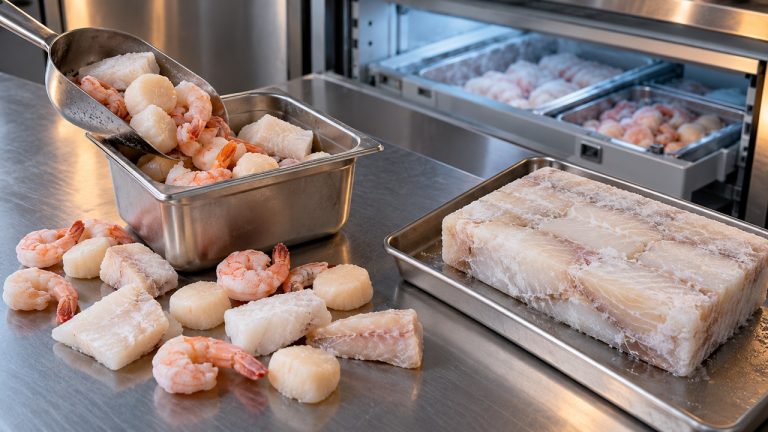
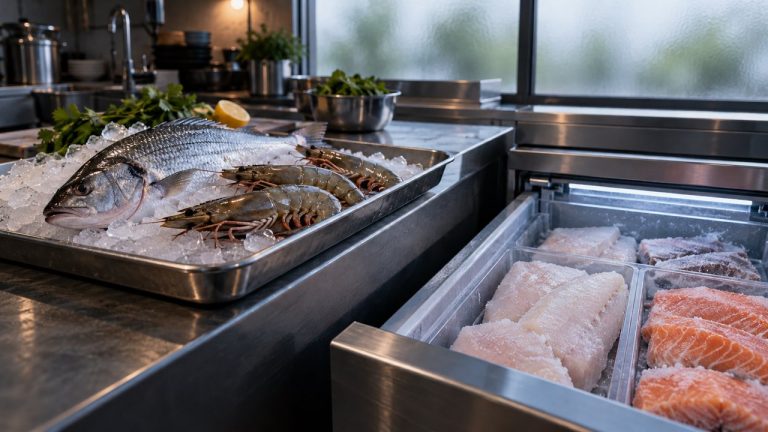
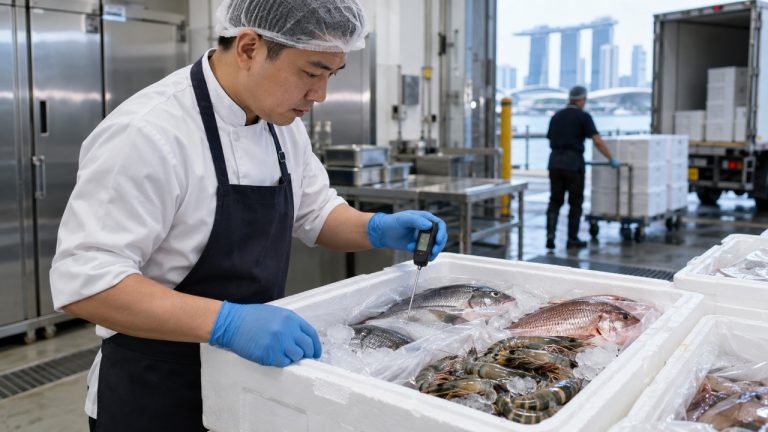
Frozen seafood does not always come in a small retail pack with an individual label. Restaurants, caterers, retailers and other food businesses may receive seafood in bulk cartons, food-service packs or containers supported by order documents and supplier specifications.
That means quality should never be judged from a label alone. Buyers should check the product, its frozen condition, the packaging or container, the information supplied with the order, and whether the seafood matches the agreed specification.
This guide explains a practical way to assess frozen seafood before buying it or accepting a delivery in Singapore.
Quick answer: what should you check?
Check these seven areas:
- Product identity and cut
- Frozen condition and signs of temperature change
- Appearance, ice and surface condition
- Packaging or container condition
- Quantity, glaze and expected usable yield
- Product information, allergens and traceability
- Supplier reliability and delivery controls
For a labelled retail pack, much of the information should be on the package. For bulk or non-prepacked seafood, confirm the same relevant details through the carton, delivery order, invoice, product specification or supplier.
1. Confirm what product you are receiving
Start with the exact product, not just a general name such as “fish” or “prawn”. Confirm details that affect preparation, yield and cost:
- seafood species or common product name
- whole, fillet, steak, loin, portion or pieces
- skin-on or skinless
- bone-in or boneless
- head-on, headless, shell-on or peeled
- raw, cooked, breaded, seasoned or otherwise processed
- individual pieces or block frozen
- agreed size, grade, count or portion range, when applicable
A product can look acceptable and still be unsuitable if the cut, size or processing does not match the order. Food businesses should compare the delivery with the purchase order or agreed product specification before accepting substitutions.
For prepacked food, Singapore Food Agency requirements apply to the label. For non-prepacked food or food supplied for further processing, relevant information may instead be provided through documentation, an electronic platform or direct communication with the supplier.
2. Check that the seafood is properly frozen
Frozen seafood should arrive and remain in a properly frozen condition. Singapore Food Agency food-safety guidance advises consumers not to buy chilled or frozen food that is displayed at room temperature.
Look for:
- a firm, fully frozen product
- no obvious soft or partially thawed areas
- no leaking liquid around the carton, bag or container
- no collapsed packaging caused by thawing
- delivery and storage conditions that match the product requirements
Heavy internal frost, large loose ice crystals or products frozen together unexpectedly can be signs that the item experienced temperature changes. These signs do not prove a safety problem by themselves, but they justify a closer check with the supplier before acceptance.
After purchase or delivery, move frozen seafood into suitable frozen storage promptly. For practical storage guidance, read How to Store Frozen Seafood Safely in Singapore.
3. Inspect appearance and surface condition
The normal appearance of frozen seafood varies by species, cut and processing method, so colour alone is not a reliable quality test.
Check for condition issues such as:
- severe drying or pale, leathery areas that may indicate freezer burn
- excessive broken pieces when whole portions were ordered
- foreign matter or visible contamination
- unusual discolouration for that specific product
- strong odour after correct thawing
- damaged flesh that does not match the agreed grade
A protective layer of ice, known as glaze, is commonly used on some frozen seafood to reduce moisture loss. Glaze is not automatically a defect. The practical question is whether the product and quantity match what was declared or agreed.
If you are unsure what normal appearance should be for a particular species or cut, compare it with the product specification or ask the supplier rather than relying on a general visual rule.
4. Check the packaging or container
The correct check depends on how the seafood is supplied.
For a sealed retail or food-service pack, look for:
- an intact seal
- no tears, punctures or leakage
- legible information where a label is required
- no obvious signs of thawing and refreezing
For bulk cartons, loose packs or non-retail containers, look for:
- a clean, intact outer carton or container
- suitable food-contact liners or inner bags where used
- protection from contamination and physical damage
- carton markings, order documents or supplier records that identify the product
- separation from chemicals or other contamination risks during delivery
Not every item needs an individual pasted label. The important point is that the product can be identified, traced and handled correctly using the information appropriate to how it is sold and supplied.
5. Compare quantity and usable yield
The lowest price per kilogram is not always the lowest cost per serving.
Consider:
- declared or ordered weight
- number and consistency of portions
- bones, skin, shell or trimming required
- ice glaze and expected thaw loss
- cooking yield
- labour needed for preparation
- whether the product format suits the dish
For prepacked frozen seafood covered with ice glaze, SFA states that the declared net weight must exclude the weight of the glaze. For bulk or food-service supply, check the agreed weight basis and product specification so the buyer and supplier are comparing the same quantity.
A restaurant may value consistent portions because they reduce preparation time and make food cost easier to control. A home buyer may prefer individually frozen pieces that allow only the required quantity to be thawed.
6. Confirm product information and traceability
Where an individual package label is present, read it. Where it is not, obtain the relevant information from the carton, delivery order, invoice, product specification, online listing or supplier.
Depending on the product and how it is supplied, useful information can include:
- product name and form
- country of origin
- ingredient list for processed or seasoned products
- allergen information
- storage instructions
- net or agreed supply weight
- lot, batch or production information
- date information, where applicable
- local importer, distributor, manufacturer, packer or supplier details
SFA states that general labelling requirements apply to prepacked food. It also states that food businesses offering non-prepacked food should provide information typically found on food labels to consumers upon request.
Allergen information is especially important for breaded, marinated, seasoned or otherwise processed seafood. If the information is unclear, do not guess. Ask the supplier and follow your organisation’s allergen procedure.
7. Assess the supplier and delivery process
Product quality is easier to manage when the buyer and supplier agree on the specification before ordering.
Confirm:
- exact product and cut
- pack or carton size
- weight or count basis
- acceptable portion range
- storage and delivery requirements
- minimum remaining shelf life, when applicable
- documents required with delivery
- process for shortages, damage or rejected goods
For larger or repeat orders, keep the agreed specification with the purchasing record and make it available to receiving staff. For broader supplier checks, read How to Choose a Seafood Supplier in Singapore.
A receiving checklist for food businesses
Restaurants, caterers and retailers can use this checklist for both individually labelled products and bulk food-service deliveries:
| Check | What to verify | Possible information source |
|---|---|---|
| Product identity | Species, cut, form, grade and pack size | Pack, carton, order or specification |
| Quantity | Carton count, pack count, weight or portion count | Delivery order, invoice or scale record |
| Frozen condition | Firm product, no obvious thawing or leakage | Physical inspection and delivery check |
| Traceability | Supplier, origin, lot or batch and delivery date | Pack, carton or supplier documents |
| Date information | Relevant date and remaining shelf life | Pack, carton or supplier documents |
| Allergens | Ingredients and allergen statement for processed products | Label, specification or supplier declaration |
| Condition | Seal, liner, carton, frost, breakage and contamination | Physical inspection |
| Exceptions | Photos, temperature record and action taken | Receiving record |
Record any exception before the product is moved into normal stock. If identity, allergen information, condition or traceability cannot be confirmed, hold the affected product separately and contact the supplier.
Frequently asked questions
Does every frozen seafood item need an individual pasted label?
No. The required information and how it is provided depend on whether the food is prepacked for sale or supplied in another form, such as bulk or non-retail food-service packaging. SFA states that general labelling requirements apply to prepacked food, while information for non-prepacked food should be available to consumers upon request.
How can I check a bulk product without an individual label?
Match the seafood to the carton, delivery order, invoice or agreed product specification. Confirm the product name, form, origin, quantity, storage requirements, allergen information where relevant, and available lot or batch details with the supplier.
Is ice glaze on frozen seafood a problem?
Not necessarily. Glaze can help protect frozen seafood from moisture loss. For prepacked glazed seafood, the declared net weight must exclude the glaze. For bulk supply, confirm how the agreed weight is defined.
Do large ice crystals mean the seafood is unsafe?
Not by themselves. They can indicate temperature variation or moisture movement, so check the product condition, packaging, delivery record and storage history before deciding whether to accept it.
What should I do if the delivered seafood does not match the order?
Photograph and record the difference, keep the affected product separate, and contact the supplier before use. Do not accept an undocumented substitution when product identity, allergens, preparation method or food cost could be affected.
Use several checks, not one signal
Good frozen seafood assessment combines product identity, frozen condition, physical appearance, packaging or container condition, quantity, traceability and supplier information. A label can be useful, but it is not the only source of information and it does not replace inspection.
Pan Ocean Singapore supplies seafood to retail, food-service and wholesale customers. Contact our team to discuss available product specifications, pack formats and delivery requirements.