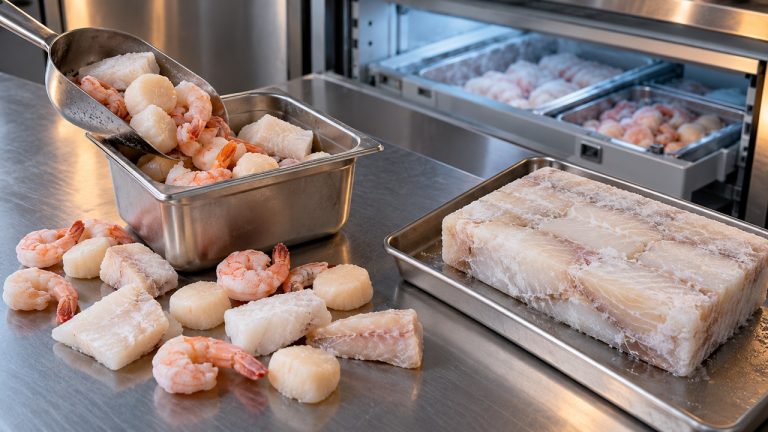
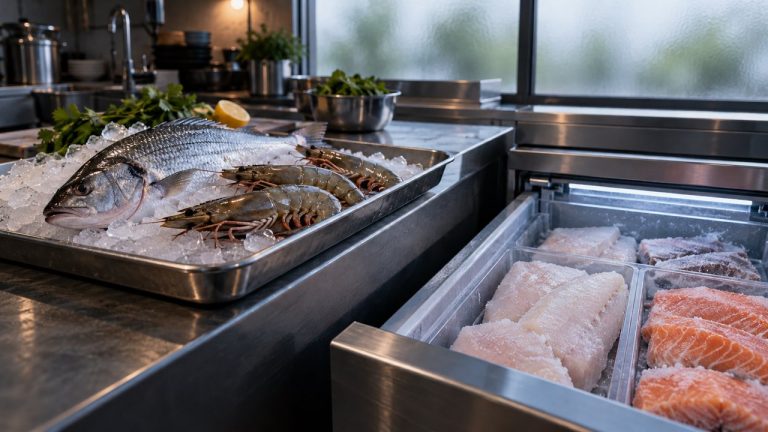
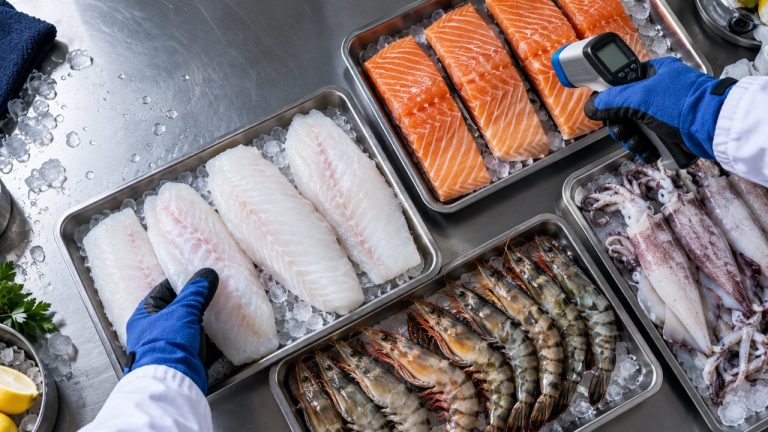
Choosing a seafood supplier in Singapore is not only a price decision. Restaurants, caterers, hotels and retailers also need consistent specifications, reliable delivery, appropriate temperature control, traceability and clear communication when supply conditions change.
The best supplier is the one that can repeatedly deliver the seafood your operation needs, in the agreed condition, format and quantity, with enough documentation and service support to reduce risk for your team.
Quick answer: what should you check?
Before appointing a seafood supplier, assess these ten areas:
- Product specifications
- Relevant licensing and source controls
- Traceability and documentation
- Cold-chain management
- Delivery acceptance standards
- Product consistency
- Processing and packaging options
- Delivery reliability and contingency planning
- Total cost, not only unit price
- Trial-order performance
Use the checklist below to compare suppliers using the same criteria.
1. Define your seafood specification first
A supplier cannot quote or deliver consistently when the requirement is vague. Start with a written product specification for every important item.
Include:
- species and common product name
- origin, when it matters to your menu or procurement policy
- fresh, chilled or frozen format
- whole, fillet, portion, steak, peeled or other cut
- skin-on or skinless, bone-in or boneless
- size grade or target portion weight
- glaze, net weight and pack size for frozen products
- preferred packaging format
- expected weekly volume and delivery frequency
Clear specifications make quotations easier to compare. They also give receiving staff an objective basis for accepting or rejecting a delivery.
2. Verify the controls relevant to the supplier’s role
Different seafood businesses may import, store, process, distribute or retail products. The licences and registrations that apply depend on the activity.
The Singapore Food Agency (SFA) states that traders importing meat and fish products for commercial sale require the relevant licence. SFA also licenses coldstores used for chilled or frozen meat and seafood, as well as meat and fish processing establishments.
Ask a potential supplier:
- What role do you perform in the supply chain?
- Which SFA licences or registrations apply to that activity?
- Can you provide the business and product documents relevant to our order?
- How do you check that imported products meet current Singapore requirements?
The purpose is not to collect certificates without context. It is to understand who is responsible for sourcing, importing, storage, processing and delivery at each stage.
3. Ask how traceability is maintained
Traceability helps a food business identify what it received, where it came from and which customers or outlets received it. This becomes especially important during a quality investigation, withdrawal or recall.
Useful records may include:
- supplier and product name
- species and country of origin
- lot, batch or production code
- packing or production date
- expiry or best-before date
- quantity received
- delivery date
- storage instructions
- relevant health certificates or import documents when required
Ask how quickly the supplier can retrieve these records. A practical system should support a prompt, product-specific response rather than a general assurance.
4. Review cold-chain management
Seafood quality can deteriorate when temperature control is weak, even if the product looks acceptable at the point of delivery.
SFA guidance states that frozen food should be maintained at -18°C or below during transport, with a core temperature not exceeding -12°C. Chilled food should be maintained at 4°C or below, with a core temperature not exceeding 7°C during transport. Products should be placed into the required storage promptly after delivery.
Discuss:
- storage and transport temperature targets
- how temperatures are monitored and recorded
- what happens when a reading is outside specification
- how loading and unloading time is controlled
- whether vehicles and containers are suitable for the product
- how chilled, frozen and ready-to-eat products are segregated
For high-volume or higher-risk purchases, request evidence that matches the product and delivery route, such as a temperature record or agreed receiving limit.
5. Agree on delivery acceptance standards
Receiving checks should be decided before the first order, not during a dispute.
Your checklist can cover:
- delivery temperature
- packaging integrity
- correct label and product identification
- pack count and weight
- signs of thawing or refreezing
- excessive ice, leakage or damaged cartons
- odour, texture and appearance where applicable
- remaining shelf life
- action for shortages or rejected items
Train receiving staff to record exceptions with photographs, temperature readings and delivery details. Clear evidence helps both buyer and supplier resolve problems faster.
6. Test consistency, not only the first sample
A good sample does not prove that every future delivery will match it. Seafood naturally varies, but commercial buyers still need predictable specifications.
Use a short trial period to review:
- portion and size consistency
- usable yield after trimming or thawing
- drip loss and glaze where relevant
- cooking performance
- flavour and texture
- packaging durability
- accuracy of cartons, labels and invoices
For restaurants, the cheapest price per kilogram may produce a higher cost per plated portion if trim loss, breakage or inconsistent sizing is high.
7. Check processing and packaging capability
The right level of processing can reduce kitchen labour and improve portion control, but only when the specification is clear.
Ask whether the supplier can provide:
- filleting, portioning or cutting
- skinning, pin-bone removal or peeling
- individual quick frozen formats
- vacuum packing or food-service bulk packs
- fixed-weight or variable-weight portions
- private-label or outlet-specific packing where required
Confirm minimum order quantities, lead times and tolerances. If a customised format is important, approve a sample and keep the agreed specification in writing.
8. Evaluate delivery reliability and contingency planning
Seafood availability can be affected by seasonality, weather, transport disruption and changes at source. A supplier should communicate early when the agreed product is unavailable.
Ask:
- Which delivery days and order cut-off times apply?
- What is the normal lead time?
- How are urgent orders handled?
- What happens when stock is delayed or unavailable?
- Will substitutions require approval before delivery?
- Is there an escalation contact for quality or delivery issues?
An alternative species, size or origin may affect allergens, menu descriptions, food cost and cooking performance. Do not accept substitutions without a defined approval process.
9. Compare total delivered value
Unit price matters, but it is only one part of the cost.
Compare:
- net edible yield
- portion consistency
- trimming and preparation labour
- delivery fees and minimum orders
- packaging and storage efficiency
- rejected or short deliveries
- credit and replacement process
- payment terms
- administrative accuracy
A slightly higher quoted price can be better value when it reduces waste, labour and service failures.
10. Start with a controlled trial order
Before moving a critical category to a new supplier, run a trial using a representative order.
Record the result against a simple scorecard:
| Area | Evidence to review |
|---|---|
| Product match | Species, cut, size, pack and quantity match the order |
| Food safety controls | Relevant documents, temperature and packaging condition |
| Quality | Appearance, texture, yield and cooking result |
| Service | Order confirmation, delivery timing and communication |
| Commercial accuracy | Price, invoice, credits and agreed terms |
| Corrective action | Speed and quality of response when an issue occurs |
Do not judge only on whether the delivery arrived. Test whether the supplier’s full process works for purchasing, receiving, storage, kitchen operations and accounts.
Questions to ask a seafood supplier
- Which products, origins and formats are consistently available?
- Which licences or registrations apply to your operation?
- How do you maintain batch and source traceability?
- How are chilled and frozen temperatures monitored?
- What are your delivery temperature and packaging standards?
- What product specifications and tolerances can you commit to?
- Which processing and packing services are available?
- What are the lead times, cut-off times and minimum orders?
- How are substitutions, shortages and rejected deliveries handled?
- Who manages urgent quality or supply issues?
Frequently asked questions
Should I choose a seafood supplier based on price?
No. Compare price together with usable yield, consistency, food-safety controls, delivery performance, labour requirements and issue resolution. The lowest unit price may not produce the lowest cost per usable portion.
What temperature should seafood be delivered at?
The correct limit depends on the product and the agreed specification. SFA transport guidance states that frozen food should be maintained at -18°C or below, with a core temperature not exceeding -12°C during transport. Chilled food should be maintained at 4°C or below, with a core temperature not exceeding 7°C during transport.
How many trial orders should I place?
There is no universal number. Use enough representative deliveries to test product consistency, timing, documentation, invoice accuracy and problem handling. Higher-volume or business-critical products normally justify a more structured trial.
What should I do if a delivery does not meet specification?
Keep the product under appropriate temperature control, separate it if necessary, document the issue and contact the supplier promptly. Follow your food-safety procedures and the agreed acceptance or rejection process. Do not use seafood when its safety is uncertain.
Build a supply relationship that reduces risk
A seafood supplier should help your operation receive the right product, in the right condition, at the right time. Written specifications, consistent receiving checks and clear issue escalation create a stronger working relationship than price negotiation alone.
For more guidance, read Why the Cold Chain Matters and How to Choose Fresh Seafood in Singapore.
Pan Ocean Singapore supports food-service, retail and wholesale customers with seafood supply, processing and cold-chain solutions. Contact our team to discuss your product specifications and delivery requirements.
Sources
- Singapore Food Agency: What You Need to Know for Import of Food for Commercial Sale
- Singapore Food Agency: Businesses that Need Licence or Registration for Food Manufacturing and Storage
- Singapore Food Agency: Transport Frozen and Chilled Food at Correct Temperatures
- Singapore Food Agency and Enterprise Singapore: SS 668 Cold-Chain Management Standards