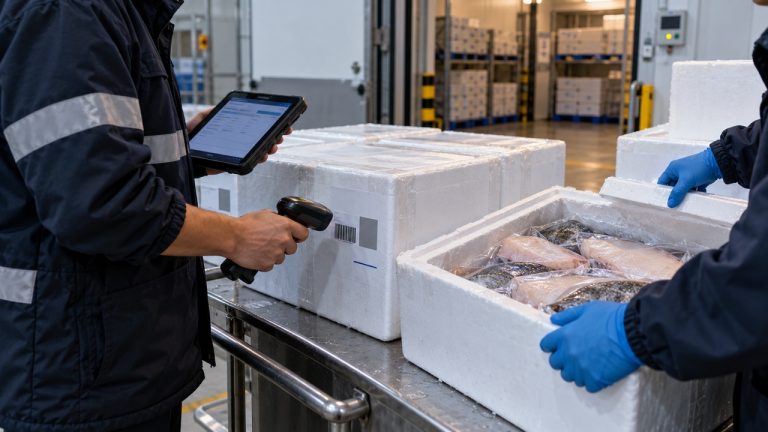
Responsible seafood sourcing is not a single logo, species list or supplier promise. It is a purchasing process that checks whether seafood is legally supplied, accurately identified, traceable to its source and supported by credible evidence for any environmental or social claim.
For Singapore restaurants, caterers, hotels, retailers and other food businesses, the practical objective is to buy seafood that meets the operation’s food-safety, legal, quality and responsible-sourcing requirements without making claims that the available documents cannot support.
This guide provides a buyer-focused checklist for evaluating wild-caught and farmed seafood. It is general procurement guidance, not legal advice or a claim about any particular Pan Ocean Singapore product.
Quick answer: what should a seafood buyer check?
Before approving a product or supplier, confirm these eight points:
- The exact species and product form.
- The country or area of origin and the supplier’s role in the chain.
- Whether the seafood is wild-caught or farmed.
- The catch method, farm information or other source details relevant to the purchasing policy.
- The legal import, product and source requirements that apply in Singapore.
- The records that connect the physical product to its source and delivery.
- The evidence behind any sustainability, certification or responsible-sourcing claim.
- How substitutions, specification changes and unsupported claims will be controlled.
The strongest decision uses all eight checks together. Certification can provide useful independent assurance, but it does not replace product identification, legal compliance, food-safety controls, quality inspection or a complete commercial specification.
What does responsible seafood sourcing mean?
The Food and Agriculture Organization of the United Nations (FAO) Code of Conduct for Responsible Fisheries sets international principles for conserving, managing and developing living aquatic resources while considering ecosystems, biodiversity and the people involved in fisheries and aquaculture.
For a food business, those broad principles need to become practical purchasing questions. A responsible-sourcing process should help the buyer determine:
- what species is being purchased
- where and how it was produced
- whether it entered the supply chain legally
- whether source information can be verified
- whether a sustainability claim has a defined standard and credible evidence
- whether the product can be traced through receiving, storage and sale
Responsible sourcing is broader than environmental impact alone. Depending on the policy or standard used, it may also consider resource management, habitat effects, animal welfare, labour and human-rights controls, community impacts and supply-chain integrity.
Start with legal sourcing and product identity
Sustainability language cannot compensate for an unidentified or illegally supplied product. Begin with the legal and product information required for the actual seafood and business activity.
The Singapore Food Agency (SFA) states that traders importing fish products for commercial sale require the relevant licence or registration and an import permit for each consignment. Fish and fish products must meet the applicable import requirements, with additional controls for certain high-risk products and species covered by CITES.
A buyer who is not the importer should still verify that the supplier and product route are appropriate for the order. Relevant information may include:
- supplier and importer identity
- product name and scientific name where needed for accurate identification
- country or area of origin
- wild-caught or farmed production method
- processing and packing establishment information, where applicable
- lot, batch, carton, delivery or purchase reference
- required permits, health certificates or source documents for the specific product
Do not treat a broad description such as “white fish”, “prawn” or “sustainable seafood” as a complete specification. Species, production method, source and product form can materially change the legal requirements, sustainability risk, yield, price and menu description.
For a broader supplier review, use our seafood supplier checklist.
Distinguish wild-caught and farmed seafood
Wild-caught and farmed seafood require different evidence. Neither production method is automatically responsible or irresponsible.
For wild-caught seafood
Useful questions can include:
- What is the species and stock or fishing area?
- Which vessel, fleet, fishery or supplier handled the product, where relevant?
- What fishing method was used?
- Is the fishery subject to catch limits, seasonal controls or a catch documentation scheme?
- Is the species covered by CITES or another product-specific requirement?
- Is there independent certification, a fishery improvement programme or another documented basis for the claim?
FAO describes a catch documentation scheme as a system that helps determine whether fish throughout the supply chain originated from catches taken consistently with relevant conservation and management measures. Not every seafood product requires a catch certificate, but the principle is useful: the claim should remain connected to verifiable product and source information.
For farmed seafood
Useful questions can include:
- What species was farmed, and where is the farm located?
- Can the product be linked to a named farm, group or production site?
- Which controls cover feed, water quality, disease management and medicine use?
- What environmental and social requirements apply to the farm?
- Is the farm certified to a recognised standard, and is the certificate current and within scope?
- Can the certified product remain traceable through processing, packing and distribution?
The Aquaculture Stewardship Council’s Farm Standard, for example, covers responsible practices relating to farm management, animal welfare, human rights and environmental stewardship. A buyer should still verify that the specific species, farm, product and supply chain fall within the claimed certification scope.
Check the evidence behind sustainability claims
Words such as “sustainable”, “responsibly sourced”, “ocean-friendly” or “eco” can mean different things unless the claim identifies its basis.
Ask the supplier:
- What exact claim is being made?
- Which product, species, farm, fishery, batch or supplier does it cover?
- Is the claim based on law, certification, an improvement programme, a company policy or another assessment?
- Who assessed it, and when?
- Is the certificate or assessment current and publicly verifiable?
- Does the scope cover the product and every relevant supply-chain business?
- What wording may the buyer legally and accurately use on menus, packaging or marketing?
Avoid converting limited evidence into a broader claim. A supplier policy does not prove that every product is certified. A fishery certificate does not automatically allow every downstream business to use a consumer-facing label. A certificate for one farm, species or product cannot support unrelated products.
Understand certification and chain of custody
Independent certification can make responsible-sourcing requirements more consistent and auditable, but the buyer must understand what the certification covers.
The Marine Stewardship Council (MSC) explains that businesses handling MSC-certified seafood may be assessed against Chain of Custody principles covering certified supply, product identification, separation, traceability and management systems. Products sold with the MSC label must remain within an eligible certified chain, and use of the label is subject to the programme’s requirements.
Aquaculture certification uses a similar supply-chain principle for farmed seafood: certification at the farm is useful only when the product can be linked through the relevant chain of custody.
When checking a certification claim:
- use the scheme owner’s current certificate or supplier directory
- match the legal business name, site and certificate number
- check status, validity dates and product scope
- confirm the certified status of the exact product being ordered
- record the certificate or supplier evidence used for approval
- check whether your business needs its own certification or label licence before making a public claim
Certification is one route to evidence, not the only possible route. When a product is not certified, the buyer should define which alternative source, management, improvement and traceability evidence is acceptable under the organisation’s policy.
Connect responsible sourcing to traceability
A claim is difficult to defend if it becomes separated from the physical product.
The purchase order, supplier specification, delivery record, outer packaging, internal receiving reference and sales or menu information should form a connected trail. At minimum, the business should be able to show:
- which approved supplier provided the product
- which product and source were ordered
- what was received and when
- which batch, lot, carton or delivery reference applies
- where the product was stored or used
- how any certified or responsible-sourcing status was preserved
If certified and non-certified seafood is handled in the same operation, follow the applicable identification, separation, record and claim controls. Do not allow similar products to be swapped merely because they share a common name.
Our guide to seafood traceability records in Singapore explains how to connect supplier, delivery, batch and customer information.
Build the requirement into the purchase specification
Responsible sourcing should be written into the buying process before quotations are compared.
An approval specification may include:
- accepted common and scientific names
- wild-caught or farmed status
- accepted origins, fishing areas or farm sources
- required catch method or production information
- legal and product-specific documents
- accepted certification or alternative evidence
- chain-of-custody and claim requirements
- product form, size, grade, pack and quality tolerances
- traceability fields required at delivery
- substitution and change-notification rules
This prevents a common failure: selecting a product on price, then asking for sustainability evidence after the order has already been placed.
Price comparisons should use equivalent specifications. A certified, traceable product and an unverified product may not represent the same purchasing requirement even if the species and pack size appear similar.
Control substitutions and changes
Seafood availability can change with season, weather, catch, farm production and logistics. A responsible-sourcing programme needs a controlled substitution process rather than a blanket “similar product accepted” instruction.
Before approving a substitute, recheck:
- species and product identity
- origin and production method
- legal and high-risk import requirements
- certification or claim status
- allergen and ingredient information for processed products
- size, grade, yield and preparation suitability
- traceability and delivery documentation
- menu, packaging or customer claims that must change
If the evidence is incomplete, hold the substitute from the claimed use until the information is confirmed. The frozen seafood quality guide provides additional receiving checks for product condition and documentation.
A practical responsible-sourcing checklist
Use this sequence for a new seafood item:
- Define the product and intended use.
- Identify the species, source and production method.
- Confirm the supplier’s role and the applicable Singapore requirements.
- Set the responsible-sourcing criteria in the specification.
- Obtain current source, traceability and claim evidence.
- Verify certificate status and scope where certification is claimed.
- Complete a trial order and check the delivered product against the approval record.
- Approve the product, reject it or document the information still required.
- Review the approval when the supplier, source, product, certificate or claim changes.
The process should be proportionate to risk and purchasing importance. A high-volume menu item, public sustainability claim or higher-risk source may justify more evidence and more frequent review.
Frequently asked questions
Does “responsibly sourced” always mean certified?
No. Certification is one structured form of evidence, but the phrase itself does not identify a standard. Ask what criteria, product scope, assessment and traceability support the claim.
Is farmed seafood less sustainable than wild-caught seafood?
Not automatically. Impacts vary by species, location, production system, farm or fishery management and supply-chain controls. Compare evidence for the specific product rather than relying on the production method alone.
Can a restaurant use a certification logo because its supplier is certified?
Not necessarily. Certification and logo-use rules depend on the programme, product and chain of custody. Confirm the current requirements with the scheme owner before using a label or making a certified claim.
Is legal importation proof that seafood is sustainable?
No. Legal compliance is the baseline for supply, but a sustainability claim may require additional evidence about the fishery, farm, environmental and social criteria, and chain of custody.
What if a supplier cannot provide every source detail?
Do not invent or assume the missing information. Decide whether the available evidence meets the written purchasing requirement. If it does not, hold the approval, narrow the claim or select another product.
Make the claim match the evidence
Responsible seafood sourcing works when the purchasing requirement, supplier evidence, delivered product, internal records and public claim all describe the same thing.
Start with one priority seafood item. Define the exact product, verify its source and claim evidence, test the traceability trail and correct any gap before expanding the programme. If your business is reviewing seafood specifications or supply formats, contact Pan Ocean Singapore with the product and operational requirements.
Sources
- Singapore Food Agency: What You Need to Know for Import of Food for Commercial Sale
- Singapore Food Agency: Import Requirements for Food & Food Products
- FAO: Code of Conduct for Responsible Fisheries
- FAO: Voluntary Guidelines for Catch Documentation Schemes
- Marine Stewardship Council: How the Chain of Custody Standard Works
- Aquaculture Stewardship Council: The ASC Farm Standard