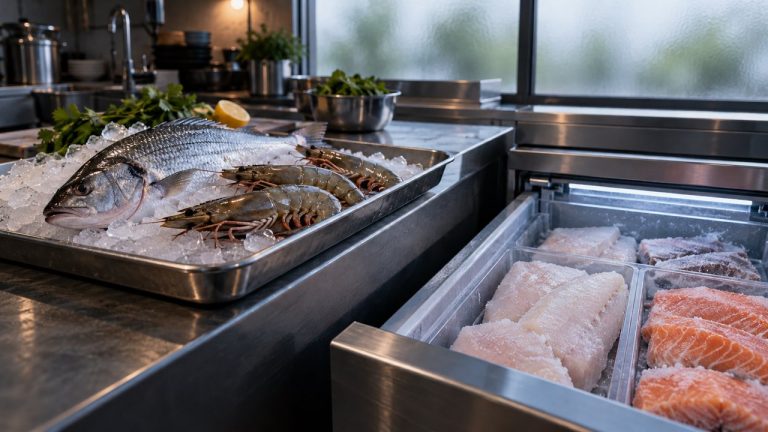
Seafood businesses need to manage more than one allergen risk. Fish, crustaceans and molluscs can be allergenic ingredients, while processed seafood may also contain wheat, egg, milk, soy or sulphites depending on the recipe and product.
The practical rule is simple: know the complete ingredient and allergen profile of every product, keep that information connected to the food, prevent unintended cross-contact, and never guess when a customer asks.
This guide explains a workable approach for Singapore restaurants, caterers, central kitchens, retailers, importers and seafood processors. It is general operational guidance, not medical advice or a substitute for requirements that apply to a specific product or business.
Quick answer: what should a food business do?
A reliable seafood allergen process should cover six controls:
- Obtain current ingredient and allergen information from the supplier.
- Check every seafood product, sauce, coating, seasoning and garnish used in the dish.
- Keep allergenic ingredients identified during receiving, storage and preparation.
- Prevent unintended allergen transfer through separation, scheduling, cleaning and suitable utensils.
- Make accurate allergen information available to staff and customers.
- Review the information whenever a supplier, product or recipe changes.
These controls should form one connected system. A menu note is not reliable if the recipe has changed, and a supplier specification is not useful if kitchen staff cannot connect it to the product being used.
Which seafood allergens are recognised in Singapore?
The Singapore Food Agency (SFA) identifies fish and crustaceans among the eight most common classes of food allergens.
For Singapore’s prepacked-food labelling requirements:
- Crustaceans and crustacean products include crayfish, prawns, shrimps, lobsters, crabs and their products.
- Fish and fish products include fish and molluscs such as oysters, clams and scallops, and their products.
Food businesses should use the exact ingredient or product name available in the specification rather than relying only on a broad description such as “seafood”. A customer may need to distinguish between fish, prawns, crab, squid, scallops or another seafood ingredient.
The complete dish also matters. Breaded fish may contain wheat and egg. A seafood sauce may contain soy or wheat. A butter-based preparation contains milk. Some seafood products may contain added sulphites. These are examples of possible formulations, not assumptions. Confirm the actual product specification and recipe.
Prepacked and non-prepacked food have different information routes
SFA states that all food businesses offering prepacked food for sale in Singapore must comply with the Food Regulations, including general labelling requirements. Ingredients and additives used in prepacked food must be declared, and ingredients known to cause hypersensitivity must be identified in the statement of ingredients.
Meals prepared after a customer orders, catering food, loose retail products and ingredients supplied to food services for further processing are examples of non-prepacked food. SFA explains that the general labelling requirements apply to prepacked food, while businesses offering non-prepacked food should still provide information typically found on food labels when consumers request it. Allergen information can be communicated through means such as menus or standees.
This distinction affects the format, not the need for accurate information. A restaurant may not place a retail label on every plate, but it still needs a dependable way to answer a customer’s allergen question.
Build an allergen information chain from supplier to customer
Allergen control starts before the seafood reaches the kitchen or production area.
1. Obtain a current product specification
Ask the supplier for information that matches the exact product, pack format and formulation being purchased. Relevant records may include:
- product name and seafood species or type
- complete ingredient and additive list for processed products
- allergen declaration
- precautionary statements, where used
- product code, pack size and supplier
- current specification or revision date
- notice process for formulation or supplier changes
For plain, single-ingredient seafood, identify the seafood correctly. For marinated, breaded, seasoned, stuffed, surimi-based or ready-to-cook products, review the full ingredient list rather than focusing only on the seafood component.
Our seafood supplier checklist covers the broader purchasing and documentation checks that support this step.
2. Verify the delivery against the approved product
Receiving staff should confirm that the delivered product matches the purchase order and approved specification. Check the product code, description, pack format and available label or carton information before accepting an unexpected substitution.
If the product or formulation differs, do not assume that its allergen profile is the same. Hold it under the business’s normal discrepancy process until the information is confirmed.
Linking supplier, product and batch information also supports investigation when information changes. See our guide to seafood traceability records in Singapore for a practical record structure.
3. Connect the information to recipes and menus
Maintain an approved recipe or product matrix that shows which allergens are deliberately present in each item. It should reflect every component, including:
- seafood and processed seafood ingredients
- marinades, sauces and stocks
- batter, crumbs and coatings
- cooking fats and dairy ingredients
- garnishes and toppings
- bought-in components and condiments
Use controlled information rather than memory. The person answering a customer should be able to check the current recipe and supplier information or escalate the question to someone who can.
Ingredient presence and cross-contact are different risks
An allergen may be deliberately present as an ingredient, or it may be unintentionally transferred from another food, surface, utensil, container or process. The second situation is commonly called allergen cross-contact.
Codex’s Code of Practice on Food Allergen Management states that food businesses should prevent or minimise allergen cross-contact, keep allergen information clear and correct, and use risk-based controls. SFA similarly advises allergen management throughout the supply chain and production process.
This is different from microbial cross-contamination between raw and cooked food, although some controls overlap. Washing and sanitising may control microbes, but an allergen programme must also consider whether allergenic protein residues have been effectively removed.
Practical controls for seafood kitchens and processing areas
The appropriate controls depend on the products, layout and volume. A practical programme may include the following.
Separate and identify ingredients
Keep ingredients in secure containers or original packaging where practical. Preserve the link to the product name and allergen information. Avoid transferring ingredients into unmarked containers.
Where space allows, separate products with different allergen profiles. Consider the risk of spills, powders, crumbs and open containers when choosing storage locations.
Plan the production sequence
If dedicated lines or work areas are not available, schedule products with simpler allergen profiles before products containing additional allergens, then complete the validated cleaning process before the next changeover.
Do not rely on sequence alone. The plan must account for shared fryers, grills, knives, chopping boards, trays, tongs, gloves, cloths and storage containers.
Use suitable utensils and equipment
Codex recommends equipment, tools, utensils and containers that can be effectively cleaned. Dedicated or clearly controlled utensils may reduce risk in some operations, but colour coding does not replace cleaning, staff training or accurate information.
Clean effectively
Cleaning procedures should specify what must be dismantled, washed, rinsed, sanitised and checked. Pay attention to crevices, seals, slicers, boards, handles, cloths and other areas where residues can remain.
The cleaning method should be appropriate to the allergen and process. If the business makes an allergen-free or similar claim, obtain specialist advice and validate that the complete control system supports the claim.
Control people and workflow
Staff should wash hands and change gloves or protective clothing when the process requires it. A clean glove can still transfer allergen residue if it touches the wrong ingredient, utensil or surface.
Train staff on the actual products and escalation process. They should know that “I think it is safe” is not an acceptable answer to an allergen question.
Do not use “may contain” as a shortcut
Precautionary allergen labelling (PAL) uses statements such as “may contain” to communicate a potential unintended presence of an allergen.
SFA states that PAL should be supported by a thorough risk assessment and used only when necessary. Excessive precautionary statements can unnecessarily limit food choices, and claims on prepacked food must be truthful and substantiated.
A precautionary statement is not a substitute for good hygiene, supplier control, separation, effective cleaning or staff training. First reduce the risk; then use an appropriate communication only when the remaining risk justifies it.
How staff should answer an allergen question
Use a consistent response process:
- Ask which allergen the customer needs to avoid.
- Check the approved recipe and current supplier or product information.
- Consider sauces, coatings, garnishes and preparation methods, not only the main seafood.
- Check the assessed cross-contact risk for the preparation area and equipment.
- If the information is incomplete or the requested control cannot be achieved, say so clearly.
- Escalate uncertain questions to the designated manager or food-safety lead.
Never remove a visible ingredient and describe the dish as free from that allergen if the remaining recipe, preparation method or cross-contact risk has not been checked.
Review changes before they reach the customer
Allergen information can become outdated when a supplier substitutes a product, a manufacturer changes a formulation, a chef revises a recipe or an outlet uses a different garnish.
Create a change check for:
- new products and suppliers
- substitutions and temporary stock
- revised product specifications
- recipe, sauce or garnish changes
- new equipment or production layouts
- menu updates
- customer complaints or near misses
Update the recipe matrix, menu information, training notes and relevant records before the changed item is served or sold.
Frequently asked questions
Is all seafood covered by one allergen category?
No. Singapore’s prepacked-food declaration groups crustaceans separately from fish and fish products. The fish group includes molluscs such as oysters, clams and scallops. Use the specific ingredient information available for the product and do not reduce every seafood question to one generic category.
Does a restaurant need a retail label on every dish?
No. Meals prepared after ordering are non-prepacked food. SFA states that the general labelling requirements apply to prepacked food, while businesses offering non-prepacked food should provide typical label information on request. Menus, standees and controlled staff information are possible communication routes.
Is a “may contain” statement enough to manage the risk?
No. SFA states that precautionary allergen labelling should follow a thorough risk assessment and be used only when necessary. It should not replace controls that prevent or minimise unintended allergen transfer.
Can staff rely on the product name?
No. A product name does not show every ingredient. Check the current ingredient list, allergen declaration and specification, especially for processed, coated, seasoned or ready-to-cook seafood.
What should a business do if allergen information is missing?
Do not guess. Keep the affected product or menu item out of the claimed use, contact the supplier or responsible manager, and provide the customer with an honest explanation of the uncertainty.
Make accurate information part of daily operations
Effective allergen management connects purchasing, receiving, storage, recipes, preparation, cleaning, staff training and customer communication. The strongest system is one that staff can use during a busy service, not a policy that sits in a folder.
Start by choosing one seafood dish and tracing every ingredient, supplier document, utensil and preparation step. Fix any information gap before expanding the review to the rest of the menu. If your business is reviewing seafood specifications or supply formats, contact Pan Ocean Singapore with the product and operational requirements.